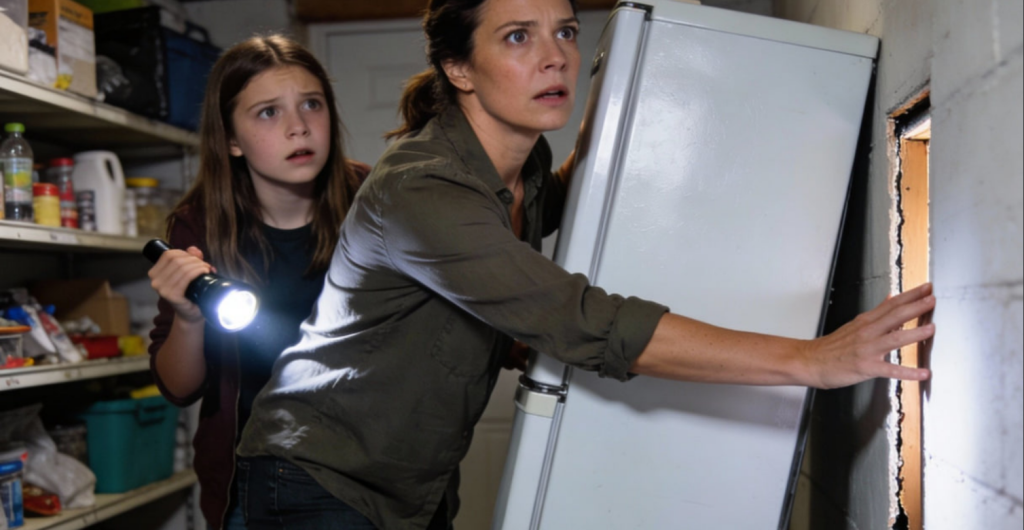
Esperaba que nuestro fin de semana en Dayton fuera fácil: dos noches en casa de mis padres, almuerzo de domingo y la típica charla. Mi hija Chloe, de doce años y curiosa, solo quería rebuscar en el sótano buscando un juego de mesa.
El sótano de mis padres no da miedo: luces brillantes, contenedores etiquetados, todo ordenado como le gusta a mi madre, Marilyn. Mientras mis padres estaban arriba debatiendo sobre el jamón, Chloe y yo bajamos a buscar el juego. Se detuvo detrás del congelador vertical y acercó la mano a la pared.
“Mamá”, dijo, “hace frío aquí”.
Los sótanos son fríos, pero esto parecía una corriente de aire. Chloe cogió una linterna y iluminó la pared con el haz de luz. La luz iluminó una junta recta, demasiado perfecta para ser una grieta. La recorrió con la mano y encontró un estrecho panel de madera pintado a juego con la pared.
—No se lo digas —susurró, y la seriedad en su voz me hizo encoger el estómago.
Empujamos el congelador hacia adelante. El panel no estaba fijo. Era una puerta camuflada con una moldura que se alineaba con la estantería. No tenía tirador, solo un pestillo empotrado cerca del fondo. Chloe metió los dedos en él y, con un suave clic, la puerta se abrió hacia adentro.
Me quedé boquiabierto.
Dentro había un hueco del tamaño de un armario con una bombilla desnuda. En el suelo había tres contenedores de plástico y una pequeña caja metálica para archivar con candado. Todo parecía limpio, como si alguien hubiera estado allí recientemente. Los contenedores estaban etiquetados con la letra de mi madre: IMPUESTOS, CASA y —me quedé sin aliento— RACHEL
Entré, levanté la tapa y vi carpetas manila apiladas como si llevaran años archivadas. La de arriba decía FINALIZACIÓN DE ADOPCIÓN. Debajo: SERVICIOS DEL CONDADO, CERTIFICADO DE NACIMIENTO ORIGINAL, FORMULARIOS DE CONSENTIMIENTO. Me quedé mirando mi nombre impreso junto a palabras que no pertenecían a mi vida.
No grité. No llamé arriba. Me obligué a dejar de temblar las manos lo suficiente para tomar fotos: etiquetas, portadas, fechas y nombres de agencias. Luego, volví a dejar todo exactamente como lo encontré. Cerré la puerta, coloqué el congelador en su sitio y subí las escaleras como si nada.
Esa noche, después de que Chloe se durmiera, me senté en mi coche y llamé al número de teléfono de un abogado de derecho familiar. A la mañana siguiente, envié una solicitud certificada a la oficina del condado, usando los términos del abogado, solicitando acceso a mi expediente de adopción sellado como adulta.
Three days later my phone rang. It was my mother. Her voice was thin and frantic, and I could hear my father shouting behind her. “Rachel,” she said, “we just got a letter from the county—why are they contacting us? What did you do?”
I didn’t answer my mother’s question right away. I asked her to read the letter to me, word for word. Between her breathless pauses and my father’s angry interruptions, I pieced it together: the county had received a formal request from an adult adoptee for records review and possible release of identifying information. The notice explained that my adoptive parents might be contacted, and that any response they wanted to provide could be added to the file. It wasn’t an accusation. It was procedure. But the panic in their house sounded like a siren.
“Are you coming back here?” my father barked in the background.
“I’ll be there tomorrow,” I said. My voice stayed steady, but my hands were shaking so hard I had to sit down on the kitchen floor.
After we hung up, I called the attorney again. She didn’t sound surprised. “Rachel, what you’re doing is legal,” she said. “The county is following policy. Your parents are reacting to the secret, not to the paperwork. Decide what you want before you confront them.”
What I wanted was simple, and also terrifying: the truth without losing my family.
I drove to Dayton at dawn, alone. Chloe stayed with my sister, thinking I was dealing with “grown-up errands.” The highway felt endless, and my mind kept flipping through memories, looking for clues. Why my baby pictures started later than my cousins’. Why my mother always insisted my birth story was “private.” Why my father got tense whenever someone joked that I looked like the mailman.
When I walked into my parents’ kitchen, the letter was spread open on the table like evidence. My father, Harold, stood near the sink with his arms crossed. My mother sat down, eyes red, fingers worrying the edge of a dish towel.
“I found the door,” I said. “And I saw the files.”
My father’s chair scraped the tile as he stood. “You went snooping.”
“I went looking for a board game with my kid,” I snapped back. “And I found my life in a bin.”
My mother’s voice cracked. “We didn’t know how to tell you.”
I waited for the explanation. Nothing came. Finally, Marilyn slid a folder toward me—one I hadn’t photographed. Inside were copies of court orders, a placement agreement, and a letter with my name typed at the top. It was addressed to them, dated years earlier, from someone named Anaïs Moreau. The paper was creased like it had been opened and closed a hundred times.
“She wrote us,” my mother whispered. “More than once.”
My stomach turned. “You hid this.”
My father’s jaw tightened. “We protected you.”
From what? The question burned in my throat, but I forced it out calmly. “Protected me from what, Dad?”
Harold exhaled hard and finally sat. The story came in clipped pieces, like he was reading a report he hated: they’d struggled to have children, they’d adopted through the county, they’d been advised to keep things “simple.” When Anaïs wrote asking for a photo and a reply, my father panicked. He believed any connection meant court, disruption, shame. He said no. He said never. He told my mother to throw the letters away, and she couldn’t, so she hid them instead—along with everything else.
My mother reached for my hand. “I wanted you to know you were loved twice,” she said, tears spilling. “I was scared you’d leave.”
That’s when my anger shifted. Not into forgiveness—not yet—but into clarity. “I’m not leaving,” I said. “But I’m also not pretending this didn’t happen. I’m getting my file. I’m answering her. And I’m telling Chloe the truth in a way that doesn’t hurt her.”
My father opened his mouth to argue, then stopped when he saw my face. For the first time, he looked less furious and more afraid—of consequences, of judgment, of the fragile story they’d built.
I took Anaïs’s letter and put it in my bag. “You can be part of what comes next,” I told them. “Or you can keep screaming at the mailbox. Either way, I’m done with secrets.”
The next few weeks moved in slow, official steps. The county didn’t hand over everything at once; they scheduled a records review appointment, and the attorney helped me file the right forms. I learned quickly that real life doesn’t resolve like a movie—there are waiting periods, stamped envelopes, and people who only return calls on Tuesdays. Still, every small confirmation felt like the floor under me was becoming solid again.
At the appointment, a clerk slid a thick file across a table and watched me like she’d seen every possible reaction. My birth name was there. So was a social worker’s summary of Anaïs Moreau: nineteen years old, newly arrived in the U.S., no close family nearby, working two jobs, terrified she couldn’t provide a stable home. The notes weren’t dramatic. They were heartbreakingly ordinary. There was also a line that hit me like a punch: “Birth mother requests future contact if child wishes, when child reaches adulthood…”
She had wanted this door to open.
With the attorney’s help, I hired a licensed intermediary—someone allowed to make first contact without violating privacy rules. Two weeks later the intermediary called me back. “She’s alive,” she said. “She lives in Michigan now. And she said yes.”
Yes.
I sat on my living-room floor and cried so hard I had to take my glasses off because they kept fogging. Then I did the hardest thing I’d been putting off: I told Chloe.
I didn’t do it with a dramatic reveal. I waited until a quiet Saturday morning, poured us hot chocolate, and said, “There’s something true about our family that I just learned. It doesn’t change how much Grandma and Grandpa love me—or how much I love you—but it matters.”
Chloe listened, eyes wide, asking the kind of direct questions kids ask: “So you grew in someone else’s belly?” “Did you know?” “Are you mad?” When I told her my birth mother’s name, she repeated it carefully, as if tasting a new word. Then she surprised me with the simplest sentence of all: “Can we meet her someday?”
I told my parents about the intermediary’s call that same night. My father went quiet, the way he does when he’s trying not to lose control. My mother cried, but this time it wasn’t just fear—it was relief mixed with grief. We set rules. No surprise visits. No guilt trips. No “after everything we did” speeches. If they wanted to be in my life, they had to let me own the truth.
The first meeting happened at a diner off I-75, neutral territory. Anaïs—who now went by “Anne” because Americans kept stumbling over the accent—walked in wearing a plain coat and carrying a small envelope. She looked like me around the eyes. That was the first shock. The second was how careful she was, as if she were approaching a skittish animal.
“I’m sorry,” she said immediately. Not sorry for giving me up, but sorry for the silence that followed. She slid the envelope across the table. Inside were copies of the letters she’d sent my parents, plus photos of herself at nineteen, holding a tiny hospital bracelet with my birth name. “I tried,” she said. “I didn’t know what else I was allowed to do.”
We talked for two hours. No grand speeches, no miraculous fixing of the past—just real questions and honest answers. She told me about the jobs, the loneliness, the regret that stayed even after she built a steadier life. I told her about my childhood, about Chloe, about how I’d found a hidden door and realized my story had been split in half.
When I hugged her goodbye, it felt strange and right at the same time—like meeting a relative I’d somehow known in my bones.
Back in Dayton, my parents and I started rebuilding with fewer lies. My father apologized the way he could: not with flowery words, but by admitting, “I was wrong to make that decision for you.” My mother handed me the remaining letters and asked if I’d read them with her someday. I said yes—on my timeline.
If you’re reading this and you’ve ever uncovered a family secret, been touched by adoption, or had to choose between keeping peace and telling the truth, I’d genuinely love to hear how you handled it. Drop a comment with your experience, or even just a “been there,” because nobody should feel alone when the floor shifts under them.
Leave a Reply